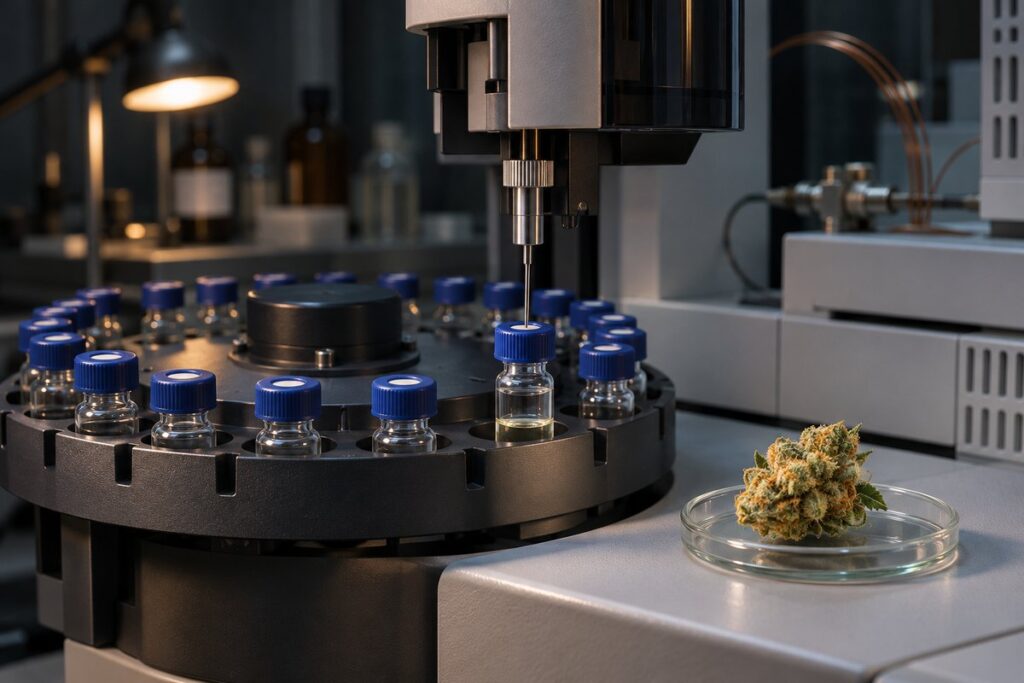
On a chart of the volatile molecules escaping from a cannabis flower, a tall peak is hard to ignore. A human nose can have entirely different priorities. A compound present in a tiny amount may announce itself before a much more abundant neighbor. That mismatch helped explain why lists of the major terpenes in cannabis long left a familiar question hanging. Where did the unmistakable skunk-like note come from?
In a chemical and sensory investigation published in 2021, Iain Oswald and colleagues identified a family of volatile sulfur compounds in cannabis. One stood out, a molecule called 3-methyl-2-butene-1-thiol. The panel described its smell as strongly sulfurous and skunk-like. It was a good candidate for a conspicuous part of the flower’s odor despite its modest abundance. That conclusion depended on listening to two witnesses with quite different capacities: a set of instruments and a small panel of people.
Why the biggest peak can lose
A gas chromatograph separates substances in a mixture so that they reach a detector at different times. Under a defined set of conditions, the area of a peak can help an analyst estimate the amount of a compound. Different detectors respond differently to different substances, so even a comparison of quantities can require calibration. No detector peak comes with an automatic conversion to how strong the material smells to a person.
For scent, the concentration at which a person can first detect a compound also matters. Suppose two substances are present in the air at the same concentration, but the threshold for detecting one is a hundred times lower. One is well above its threshold while the other may be barely perceptible. Real mixtures are more complicated, since compounds can mask or alter each other’s character. Still, the threshold idea explains why measuring abundance alone can send a search for an odorant in the wrong direction. Earlier work comparing chemical signals and odor impact illustrates how researchers tackle the mismatch.
Following the sulfur through a crowd
Cannabis releases many volatile compounds at once. When two emerge close together in an ordinary separation, a small signal can be difficult to distinguish beside a much larger one. The 2021 team used two-dimensional gas chromatography to give overlapping substances another chance to separate. A sulfur-sensitive detector helped narrow the search. Mass spectra and comparisons with reference material helped establish the identities of the candidate compounds.
Identification still left the question of smell. The researchers considered how the chemical measurements varied across samples with different sensory ratings. They also examined what happened when candidate compounds were smelled in mixtures. Those checks connect the name on an instrument printout to a recognizable change in an aroma. A match between a chemical peak and a pungent sample would be much less convincing on its own, since dozens of molecules can travel together in the same flower.
One strong note among several
The sulfur finding explains a recognizable part of cannabis aroma. It leaves ample room for differences between flowers. A later study of unusual cannabis aromas examined minor compounds associated with other descriptors, including fruity notes. A separate study of the words consumers use for cannabis smells approached the subject from the opposite end, asking how people describe and group aromas before assigning them to particular molecules.
The two ends of the investigation meet in a simple comparison. A chemist interested in the bulk composition of a sample has good reason to start with its major constituents. Someone interested in the first thing a visitor smells on opening a container has good reason to examine the air above it, the thresholds of its occupants and what they smell like together. A trace peak and a strong first impression can be measurements of exactly the same sample.