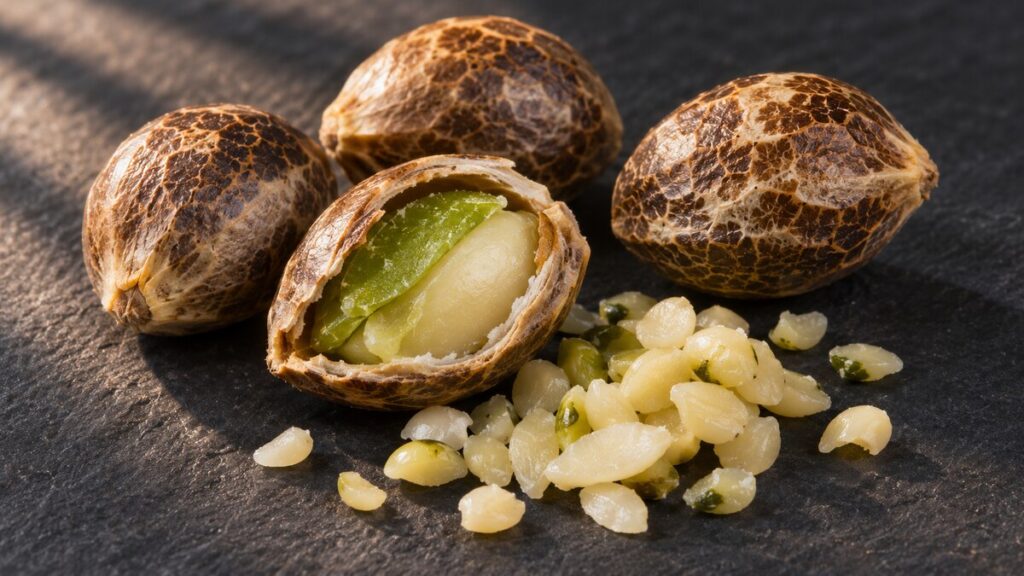
Tip whole hemp seeds onto a plate and they roll. Tip hulled hemp hearts onto the same plate and they settle into a softer, uneven heap. The difference is obvious to the fingertips. It looks stranger on a nutrition panel: removing part of the seed can increase the reported protein and fat. The missing hull has no way of creating either. It changes which parts of the plant make up a measured spoonful.
Follow one seed, then follow one hundred grams
A whole seed includes a tough outer covering around a kernel rich in oil and protein. Removing the covering takes away material that contributes disproportionately to the fiber content. The retained kernel can therefore contain more fat and protein per hundred grams than the whole seed did. If instead you followed a single seed through the process and collected everything that came off it, the protein in the resulting heart could hardly exceed the protein in the seed you started with.
Imagine an unpeeled orange and an equal weight of peeled segments. The second sample includes more flesh because none of its weight is taken up by peel. The comparison is fair if the question is what someone gets from eating a fixed weight. It is a different experiment from peeling one orange and asking what has been removed. Hemp studies use both ways of thinking. Their denominator is what allows the apparent paradox to dissolve.
In a comparison of whole, hulled and germinated hemp seeds, the dehulled samples contained higher concentrations of protein and fat and less fibrous material than the whole seeds. Measuring components on a dry-matter basis allowed the researchers to compare them without mistaking differences in water content for differences in the seed solids. A number calculated per hundred grams of dry matter and one printed per hundred grams as sold can differ even when both laboratories have done their sums correctly.
Fiber is only part of what leaves
The outer fraction also contains plant chemicals that contribute little to the weight on a nutrition panel. The same experiment found lower total phenolic content after dehulling. A separate chemical comparison of whole and dehulled seeds examined how the choices of seed material and chemical measurement affected the picture. An assay reporting phenolic compounds describes something about a sample’s composition. It cannot tell us by itself what eating that food will do to a person’s health.
What does the word protein leave out?
A protein figure on a label gives the reader a quantity. Assessing its nutritional quality adds questions about amino acids and digestion. In work on hempseed products from western Canada, researchers evaluated protein using an amino acid score corrected for digestibility. That is a different measurement from weighing total protein. It asks how a source compares with a reference pattern of essential amino acids, while accounting for how digestible the protein appears in the assay.
A researcher can therefore conclude that hulled seed supplies more protein per fixed weight without establishing that every amino acid increased in the same proportion, or that a particular person will digest precisely the fraction printed in a study. Variety, processing and the rest of the diet all remain relevant when moving from a sample to a meal. A review comparing different hempseed fractions illustrates how markedly a hull, a kernel, a pressed meal and an oil can differ despite sharing the same plant name.
Return to the plate
The simplest kitchen comparison uses equal weights and keeps the labels from the two packages. Equal spoonfuls need not weigh the same, and a package’s suggested portion may differ from its neighbor’s. With that arithmetic accounted for, the chemistry has a pleasingly physical explanation. The crunchy piece taken away with the hull carried a substantial share of the seed’s fiber. The soft heart left behind carries much of its oil and protein. What seemed like a nutritional transformation began with somebody separating two visibly different parts of a seed.